from extremetech.com
Over the years, iPhone owners have often wondered aloud if Apple was doing something to slow down older devices. Now, we know that yes, it does do that. Just a few days after admitting that it has been quietly throttling older iPhones with degraded batteries, a pair of lawsuits have been filed against Apple alleging fraud and deceptive practices.
It became clear during the last few iOS version updates that Apple had opted to apply performance throttling to older devices. It wasn’t until Geekbench ran comparisons with various iOS versions that iPhone owners had any proof. Apple was forced to issue a statement in which is admitted to slowing down iPhones. In some ways, its position makes sense, but the way it handled the situation is terrible.
The situation has to do with how lithium-ion batteries age. We’re all familiar with batteries losing capacity as they get old, but they also have less voltage. It turns out Apple didn’t include enough headroom for the battery, and its voltage can fall below what is needed to power the custom A-series system-on-a-chip. Without enough voltage, the phone can just shut down without warning. Apple’s solution to this was to add performance throttling to iOS based on battery voltage. So, if your battery is degrading, your phone gets slow.
The first class-action lawsuit filed in Illinois accuses Apple of violating the Illinois Consumer Fraud and Deceptive Business Practice Art. Specifically, the filers point to Apple’s decision not to notify users it was going to throttle their phones. As had been pointed out, very few would suspect a battery issue as the root cause of sluggish performance. That could lead consumers just to buy a new phone, which is to Apple’s advantage.
Another suit filed in Los Angeles claims Apple’s phone throttling plan “was never requested or agreed upon.” This suit also suggests Apple is hoping to get consumers to upgrade by slowing down their phones rather than simply reporting that the hardware might need service.
It looks like Apple’s decision to introduce this “feature” secretly is the main issue here. Even if Apple’s intentions were pure (which is certainly up for debate), making these performance changes in secret looks very suspicious. For a company that claims to care about the user experience, this whole fiasco makes Apple look quite disconnected from the concerns of its customers. Class actions like these are notoriously slow to litigate, so iPhone owners might end up with a small settlement in a couple years.
Showing posts with label lawsuit. Show all posts
Wednesday, December 27, 2017
Monday, July 14, 2014
iPad tied to boy's nickel allergy
from cbc.ca
The iPad is a potential source of nickel allergy reactions, say pediatricians who suggest parents choose a metal-free cover for the electronics.
Allergic contact dermatitis is becoming more common in children, especially nickel, dermatologists say. In Monday’s issue of the journal Pediatrics, doctors in the U.S. describe the case of an 11-year-old boy with dermatitis that didn’t respond to standard ointment.
He tested positive in a skin patch test for nickel allergy. At an avoidance counselling session, doctors became aware that the family had bought a first generation iPad in 2010 and that the patient was using it more frequently.
After covering his iPad and avoiding nickel, including through diet, the dermatitis improved significantly for five months, Dr. Sharon Jacob of Loma Linda University in California and Dr. Shehla Admani of the dermatology department at the University of California, San Diego, said.
Allergic reactions to Apple laptops and iPhones have been reported, but the iPad hasn’t come up as a potential source of nickel sensitization in children before, the researchers said.
They suggested patients could reduce contact between skin and devices either by using a case or cover that is nickel-free or simply applying duct tape to create a barrier.
Doctors should also consider "metallic-appearing electronics and personal effects" as potential sources of nickel exposure, Jacob and Admani said.
In 2008, dermatologists warned, people who use their cellphones for long periods may develop a rash on their ears or cheeks.
The iPad is a potential source of nickel allergy reactions, say pediatricians who suggest parents choose a metal-free cover for the electronics.
Allergic contact dermatitis is becoming more common in children, especially nickel, dermatologists say. In Monday’s issue of the journal Pediatrics, doctors in the U.S. describe the case of an 11-year-old boy with dermatitis that didn’t respond to standard ointment.
He tested positive in a skin patch test for nickel allergy. At an avoidance counselling session, doctors became aware that the family had bought a first generation iPad in 2010 and that the patient was using it more frequently.
After covering his iPad and avoiding nickel, including through diet, the dermatitis improved significantly for five months, Dr. Sharon Jacob of Loma Linda University in California and Dr. Shehla Admani of the dermatology department at the University of California, San Diego, said.
Allergic reactions to Apple laptops and iPhones have been reported, but the iPad hasn’t come up as a potential source of nickel sensitization in children before, the researchers said.
They suggested patients could reduce contact between skin and devices either by using a case or cover that is nickel-free or simply applying duct tape to create a barrier.
Doctors should also consider "metallic-appearing electronics and personal effects" as potential sources of nickel exposure, Jacob and Admani said.
In 2008, dermatologists warned, people who use their cellphones for long periods may develop a rash on their ears or cheeks.
Tuesday, February 4, 2014
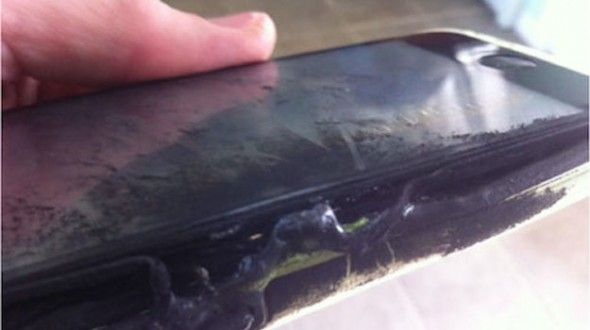
Flaming iPhone 5c Battery Sets 13-Year-Old’s Pants On Fire
from cultofmac.com
Batteries are potentially volatile things, stuffed with electrochemical cells practically humming with electrolytes. Every once and a while, then, they’re sure to break down, and companies like Apple do literally everything in their power to make sure it doesn't happen.
Here’s why. An iPhone 5c that exploded in the pocket of a 13-year-old girl resulted in a fire so severe that she was rushed to the hospital with second-degree burns.
The iPhone was in the girl’s back pocket at the time, so it appears that the failure of the two-month iPhone might have been due to stress. She may have cracked it sitting down.
As a bigger guy who stuffs his iPhone in his own back pocket, I should probably pay attention to this girl’s misfortune before I set my ass on fire.
Batteries are potentially volatile things, stuffed with electrochemical cells practically humming with electrolytes. Every once and a while, then, they’re sure to break down, and companies like Apple do literally everything in their power to make sure it doesn't happen.
Here’s why. An iPhone 5c that exploded in the pocket of a 13-year-old girl resulted in a fire so severe that she was rushed to the hospital with second-degree burns.
The iPhone was in the girl’s back pocket at the time, so it appears that the failure of the two-month iPhone might have been due to stress. She may have cracked it sitting down.
As a bigger guy who stuffs his iPhone in his own back pocket, I should probably pay attention to this girl’s misfortune before I set my ass on fire.
Friday, May 18, 2012
Apple: Viruses, Bugs And A Shrinking Reputation
They might be the biggest company in the world, but a raft of problems with new products are in danger of spoling the near-flawless reputation Apple has built for itself
This is all especially bad because Apple built its reputation not just on fine design but also on great customer service, stuff that just works straight out of the box and elegant, bug-free software. That is no longer the case and in a world where reputation is all, you ignore customers at your peril.
With a mini iPad and a large screen, ‘liquid metal’ iPhone out this year, one could easily conclude that Apple – now the world’s largest company – is unstoppable. But chinks in Apple’s armour are starting to appear and Apple’s customers are getting upset. Their reputation for innovative design is unmatched but, like Microsoft in the nineties, Apple is now releasing software with bugs in it, hardware that’s faulty and customer service that leaves a lot to be desired.
I bought a new iPhone 4S recently worth £600 (Apple sells the most expensive smartphones) and immediately noticed signal issues. Sure enough, when I walked around with an older iPhone on the same network side by side, the signal bars on my new phone were lagging behind. I was pretty shocked it didn’t work perfectly straight out of the box – given the furore over Apple’s previous iPhone 4 antennae issues and given that the newer phone uniquely actually has twin antennae.
Without a software update just a few days old, the iPhone 4S always favours a 3G signal, even in areas where that signal is sparse (its US centric virtual assistant, Siri, needs 3G to operate). That’s seven months after the phone was released. Before that, it was even worse. For the first five months users were much more likely to get ‘No Service‘ as they couldn’t switch off 3G at all. Even the Vodafone guy who sold it to me admitted after I returned to the shop, “The iPhone’s great – just not great as a phone.”
That’s not the only reason the iPhone 4S doesn’t always work straight out of the box. To the consternation of most international travellers who buy local sims and swap them into different phones, Apple decided to introduce the ‘micro-sim’ in its iPhone 4 and 4S. Unfortunately, the world’s mobile companies haven’t kept pace. Sims come in 128k, 64k, 32k varieties and global telecom networks are not all using the same system. iPhone customers with China Mobile are still waiting for a software patch to make their sim cards compatible with the iPhone 4S. And China Mobile is the world’s largest telecoms company with 650 million subscribers.
Even the Vodafone guy who sold it to me admitted after I returned to the shop, “The iPhone’s great – just not great as a phone.”
China Mobile is too big for Apple to ignore though it has ignored plenty of customers in other countries. In fact, remaining silent is becoming a very common complaint about Apple.
Customers who have recently bought the new iPad are complaining that the device overheats, that the the battery status is not accurate and, most significantly of all, that it continually loses Wifi connectivity. The Apple internet forums are jammed with complaints – and these forums tend to be where customers find out what’s really going on with Apple products.
Sometimes Apple’s silence can really have a devastated effect. In April, 600,000 Macs were infected with the Flashback virus, designed to steal their bank passwords. I have a Mac and I get plenty of emails from Apple about their products. But Apple support advised me not to get anti-virus protection as ‘Macs don’t get viruses’. Why weren’t all Mac users emailed about this one? In fact, Apple’s slow response to the virus has angered many IT professionals and almost certainly exacerbated global infection rates, leaving large swathes of users more vulnerable than they should have been. Expect some lawsuits soon (on top of that just brought by the US government for ebook price fixing).
All this makes the minor bugs look… well, minor. But when you experience them, it’s very frustrating. iOS 5 for the iPhone came with a bug affecting battery life (after a long history of iPhone battery issues). After the latest iPad software update, many users – myself included – had trouble retrieving IMAP emails. After much internet searching I found that if I manually exit and restart the iPad Mail app it will work again for a while – hardly a great solution. I have always used my Macbook Pro in clamshell mode (i.e. closed) when plugged into an external monitor. The latest update prevents it. And these bugs are not getting fixed or responded to. Users generally have to wait months for new software updates in the hope that if enough people jam the message boards and forums with complaints, Apple will release the fix.
in a world where reputation is all, you ignore customers at your peril.
Finally, what of Apple’s flagship service – the iCloud? Apple’s vision is a world where all your data, music, film, work etc is no longer on any physical machine. It’s all stored in the iCloud – accessible as and when you need it – on any device. Soon that is going to get critical mass and Apple is predicting a post PC world. But what’s going to happen when something goes wrong.. when the unthinkable happens? What happens when a virus gets into the iCloud and shuts it down? If Apple’s flagship service sinks in a titanic global data earthquake, their much vaunted and vital customer loyalty would vanish. This colossus of a company might well go down for good.
Wednesday, April 11, 2012
Apple Sued by DOJ
from WashingtonPost.com
Apple and five of the publishing industry’s top firms were accused of working together to fix prices on e-books in a Justice Department suit Wednesday. Three publishers — Hachette, Simon and Schuster and HarperCollins — agreed to settle. Apple, Penguin Group and Macmillan did not agree to settle. Macmillan’s chief executive said Wednesday that the firm would fight the charges in court.
In its complaint, the Justice Department lays out a narrative of collusion at the highest levels of the tech giant and some of the nation’s biggest publishing houses. The filing is filled with accounts of high-priced lunches, phone calls between chief executives and barbs thrown at the “holdout major publisher,” likely Random House, which took longer to switch to Apple’s agency model.
Here are some highlights from the filing:
- The complaint paints Apple’s late co-founder Steve Jobs as dismissive toward concerns that the companies might be in unethical territory. In her remarks, acting antitrust chief Sharis Pozen pointed to a Jobs quote to illustrate that attitude. According to the complaint, Jobs told the publishers, “the customer pays a little more, but that’s what you want anyway.”
- Amazon looms large in the filing. At several points, the lawsuit quotes executives complaining about the e-reader giant’s $9.99 price point. Publishers reportedly told Apple that the “price for new releases is eroding the value perception of of their products in customer’s minds, and they do not what this practice to continue for new releases.”
- The complaints turned to fury when Amazon announced that it would let copyright holders publish their books directly through the online retailer.
Penguin USA chief executive David Shanks reportedly responded, “[on] Apple I am now more convinced that we need a viable alternative to Amazon or this nonsense will continue and get much worse.” He is quoted as saying he was “‘p****d’ at Amazon,” and the filing said Shanks “expressed his desire to screw Amazon.”
- The suit also alleges that the publishing firm chiefs coordinated an effort to stand strong against the Web retailer and maker of the enormously successful Kindle e-reader, encouraging members to “hold back your books from Amazon.” At one point, Macmillan asked Amazon to convert to Apple’s agency model. When Amazon refused, the publishing firm essentially stopped selling its books on the Web site. The suit quotes the chief executive of another publishing firm telling Macmillan’s CEO: “I can ensure you that you are not going to find your company alone in the battle.”
- The suit accuses Penguin and Shanks of taking lead in criticizing a “holdout major publisher,” telling that publisher that it was “not helping” the group.
According to the complaint, Jobs refused to sell books from the holdout publisher unless it “agreed to an agency relationship substantially similar” to Apple’s arrangements with the other companies.
- Justice has also presented evidence that the publishers agreed to sign on to the agency model only if all did so together, and that two CEOs admitted under oath that they had called other publishers “specifically to learn” whether they would sign with Apple before the iPad launch.
Subscribe to:
Posts (Atom)